Blended Learning Strategies That Work for Elementary and Middle School Students
What Blended Learning Actually Means in Grades 3–7
Blended learning combines in-person instruction with purposeful use of digital tools — giving students some control over time, place, or pace while keeping the teacher at the center of the learning design. It is not simply adding tablets to a classroom. The teacher still plans, guides, and adjusts everything students experience.
Where the approach gets interesting is in how it needs to shift depending on the age of the learner. A third grader and a seventh grader are at very different developmental stages, and a strategy that works beautifully in one setting can fall flat — or even backfire — in the other.
Elementary learners in grades 3–5 tend to thrive with clear structure, physical movement, and frequent teacher check-ins. They need shorter work cycles, concrete tasks, and immediate feedback. Middle schoolers in grades 6–7 are beginning to develop the executive function and self-awareness to handle more independence — but they are not there yet, and they still need scaffolding and strong teacher relationships to stay on track.
The best blended learning models in the 3–7 range are built around this reality: technology supports learning, relationships drive motivation, and structure creates the safety students need to take risks.
The Station Rotation Model: A Natural Fit for Elementary Classrooms
Station rotation is one of the most practical and widely used blended learning models for grades 3–5. Students rotate on a schedule between three or four learning stations — typically a teacher-led small group, a peer collaboration activity, and an independent digital task — while the teacher works closely with one group at a time.
What makes this model work for younger learners is the built-in movement and predictability. Third and fourth graders know exactly what is coming next, which reduces transition anxiety and keeps the pace up. While one group practices reading fluency on a program like Lexia or Khan Academy, the teacher pulls a small group for a targeted phonics or comprehension lesson. A third group might be working through a hands-on science observation together.
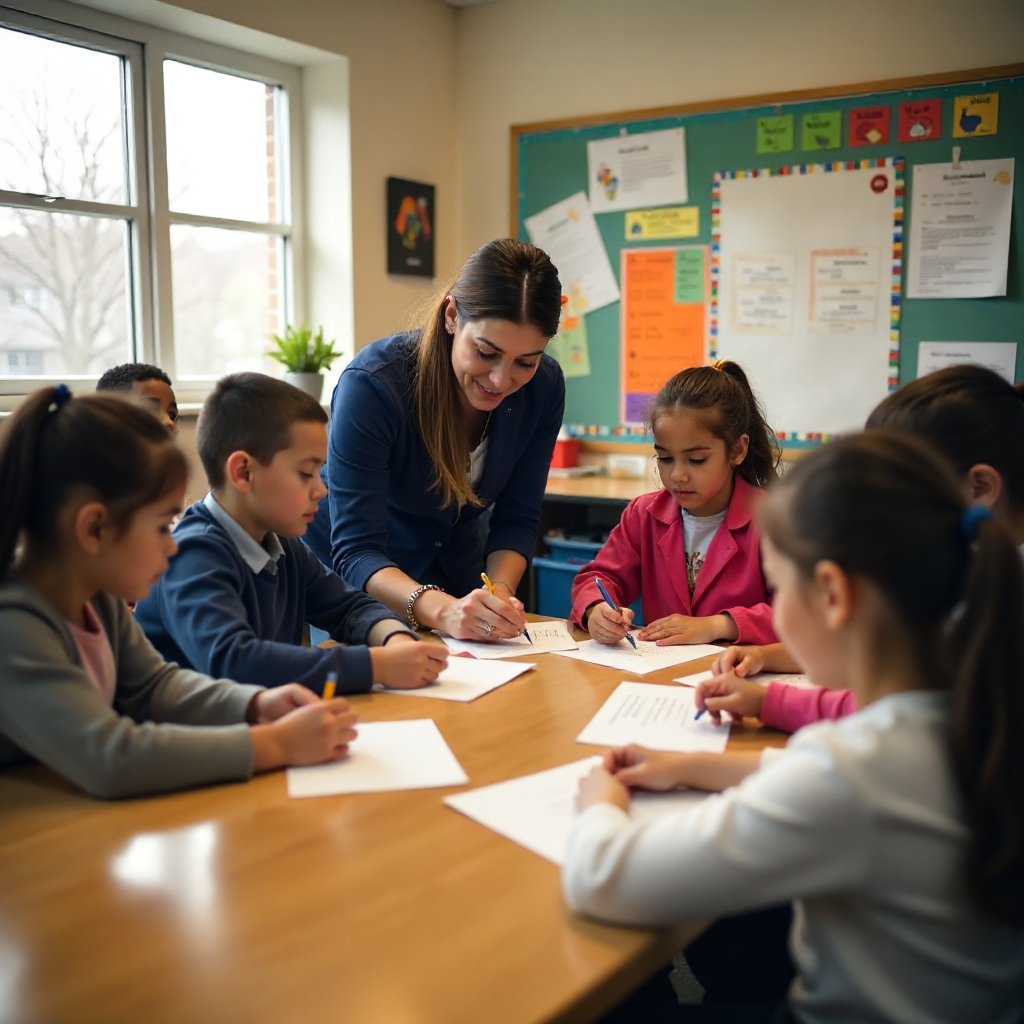
The key design decisions in station rotation are timing and grouping. Stations that run 15–20 minutes tend to match elementary attention spans without cutting too short. Grouping should be flexible — sometimes by skill level for targeted instruction, sometimes mixed for peer learning. Locking students into fixed ability groups removes the equity benefits the model can provide.
One honest trade-off: station rotation requires significant upfront planning. Teachers need to prepare three simultaneous activities, ensure the digital station is genuinely instructional (not just a game or a time-filler), and manage transitions smoothly. The payoff — consistent small-group time with every student — is real, but the prep time is, too.
Giving Middle Schoolers More Control: Self-Paced and Flex Models
Grades 6–7 students benefit from blended models that build student agency — giving them meaningful choices about how and when they work through content, within a clear structure set by the teacher. The self-paced learning model and the flex model both do this, though in different ways.
In a self-paced model, students move through a sequence of lessons or modules at their own rate. A student who grasps a concept quickly moves on; a student who needs more time gets it without the pressure of keeping up with a class-wide pace. Teachers use data from the learning management system to see where each student is and pull individuals or small groups for targeted support.
The flex model goes a step further: students have more input into their learning path, not just their pace. They might choose between video explanations, written text, or a teacher-led session to learn new content, then demonstrate understanding through a project or assessment. This works well in middle school because early adolescents are developing a genuine sense of what learning approaches work for them — and giving them that insight is valuable preparation for high school and beyond.
Guardrails matter here. Without structure, increased flexibility can become a productivity problem — especially for students who struggle with focus or self-regulation. Effective teachers using these models set weekly progress benchmarks, hold brief individual check-ins, and use formative assessment data to identify students who need more direct intervention before they fall behind.
Choosing the Right Digital Tools Without Overloading Students
The most effective digital tools in a blended classroom are the ones that do something a teacher alone cannot easily do for 25 students simultaneously — like tracking every student's progress in real time, adapting the difficulty of practice problems automatically, or giving immediate feedback on a writing draft. When a tool can't do at least one of those things, it may not be worth the screen time it consumes.
A simple framework for evaluating digital tools in grades 3–7:
- Does it give the teacher usable data? If the platform doesn't show you which students are stuck and where, it's mostly noise.
- Does it require active thinking from students? Passive video watching or click-through slides don't qualify as blended learning.
- Can students use it independently without constant troubleshooting? If a third grader needs adult help every five minutes, the station breaks down.
- Does it complement rather than duplicate what the teacher does? Technology should extend learning time, not replace direct instruction.
Families often worry — reasonably — about how much time children spend on screens. The honest answer is that screen time in a well-designed blended classroom is purposeful and bounded. A student might spend 15–20 minutes on a digital task during a station rotation, then spend the next 20 minutes talking with a teacher and peers. The total screen exposure is often less than families assume, and the type of engagement matters more than raw minutes.
According to the U.S. Department of Education, technology is most effective in learning environments when it is integrated with sound pedagogy rather than used as a standalone intervention.
How Teachers Facilitate (Rather Than Just Instruct) in a Blended Classroom
In a blended learning environment, the teacher's role shifts from primary information-deliverer to learning architect and facilitator. This is a real shift in daily practice, not just a change in terminology.
Where a traditional classroom might have a teacher leading whole-class instruction for most of the day, a blended classroom teacher spends significant time on three different activities: designing the learning pathways students move through, analyzing data from digital platforms to identify who needs what, and conferencing directly with individual students or small groups.
That last piece — the individual conference — is where blended learning can deepen teacher-student relationships rather than weaken them. When students are working independently or in small groups, the teacher has protected time to sit with a student, look at their work together, and have a real conversation about their thinking. That kind of interaction is hard to find in a whole-class model.
Teacher facilitation also includes watching for students who are struggling with the blended structure itself — not just the academic content. Some students, especially in grades 3–4, need more support managing independent work time before they can use it productively. Building those habits explicitly is part of the teacher's job in this model.
Differentiating Instruction Across a Mixed-Ability Classroom
Blended learning makes differentiated instruction more manageable — not effortless, but genuinely more achievable than trying to differentiate during whole-class instruction. The structure creates the space for it.
In a station rotation, the teacher-led group is already a small group — five to eight students instead of twenty-five. That makes it realistic to target instruction at a specific skill gap, use materials at the right reading level, and actually hear what students are thinking. Adaptive digital platforms can simultaneously provide grade-level practice for students who are on track while offering targeted review for students who need it, without anyone feeling singled out.
Across the 3–7 grade span, differentiation looks different in practice:
- Grades 3–5: Differentiate by readability level and concrete versus abstract presentation. Visual supports, manipulatives at one station, and audio options on digital tools go a long way.
- Grades 6–7: Differentiate by complexity and depth of task. Two students might work on the same standard, but one explores a surface-level application while another extends into analysis or design.
One common mistake worth naming: treating blended learning as a fix for differentiation rather than a tool that makes it easier. The structure helps, but teachers still need a clear understanding of where each student is and where they need to go. The data from digital platforms is only useful if teachers read it and act on it.
What Families Should Know About Blended Learning at a Charter School
Families at a public charter school like Kaʻu Learning Academy often have thoughtful questions about blended learning — and those questions deserve direct, honest answers rather than promotional talking points.
Blended learning at a community-oriented school is designed to reflect the school's values: strong student-teacher relationships, respect for individual learning differences, and a belief that students should have a voice in their own education. The technology is a tool in service of those values, not a replacement for them.
On the question of academic rigor: a well-implemented blended model holds students to the same standards as any other approach, but it creates more frequent checkpoints along the way. Teachers can identify a student who is falling behind on a specific skill weeks earlier than a traditional model might allow, and provide support before the gap widens.
Families can support blended learning at home without needing to become tech experts. The most valuable thing a parent or guardian can do is ask their child to explain what they worked on that day — not "did you finish your assignment," but "what were you figuring out?" That kind of conversation reinforces the reflective habits that make self-paced and flex models work.
Frequently Asked Questions
How much of the school day is spent on screens in a blended learning classroom?
Screen time in a blended classroom typically makes up 20–40% of instructional time, depending on the model and grade level. Station rotation, for example, means students are on a device for one station out of three or four — roughly 20–30 minutes of every 90-minute block. The goal is purposeful use, not maximum use.
Does blended learning work for students who struggle with reading or focus?
Yes, though it requires intentional design. Adaptive reading platforms can meet struggling readers at their actual level without embarrassment. Students who struggle with focus tend to benefit from the shorter, varied work cycles in station rotation — the built-in transitions reduce the demand for sustained attention on any single task. Teachers still need to monitor these students closely and provide additional structure as needed.
How do teachers track progress when students move at different paces?
Teachers use a combination of digital platform dashboards, regular formative assessments, and direct observation. Most learning management systems used in grades 3–7 provide real-time data on which students have completed which tasks and where they are making errors. Teachers review this data — typically daily or a few times per week — and use it to plan small-group instruction and individual check-ins.
What is the difference between blended learning and fully online school?
Blended learning is always anchored in a physical classroom with a teacher present. The digital component supplements and personalizes in-person instruction; it does not replace it. Fully online school, by contrast, delivers most or all instruction through a screen with limited in-person interaction. The teacher relationship, the community of the classroom, and hands-on learning experiences are all central to blended learning in a way they often are not in fully online models.
How can parents support blended learning routines at home?
The most effective support doesn't require a parent to understand every platform their child uses. Ask your child what they chose to work on and why. Ask what was hard. If the school provides access to a learning platform at home, a consistent 20–30 minute homework routine — not more — is plenty for grades 3–7. The habits of reflection and self-monitoring matter more than the number of minutes logged.